
Before every walk — five seconds
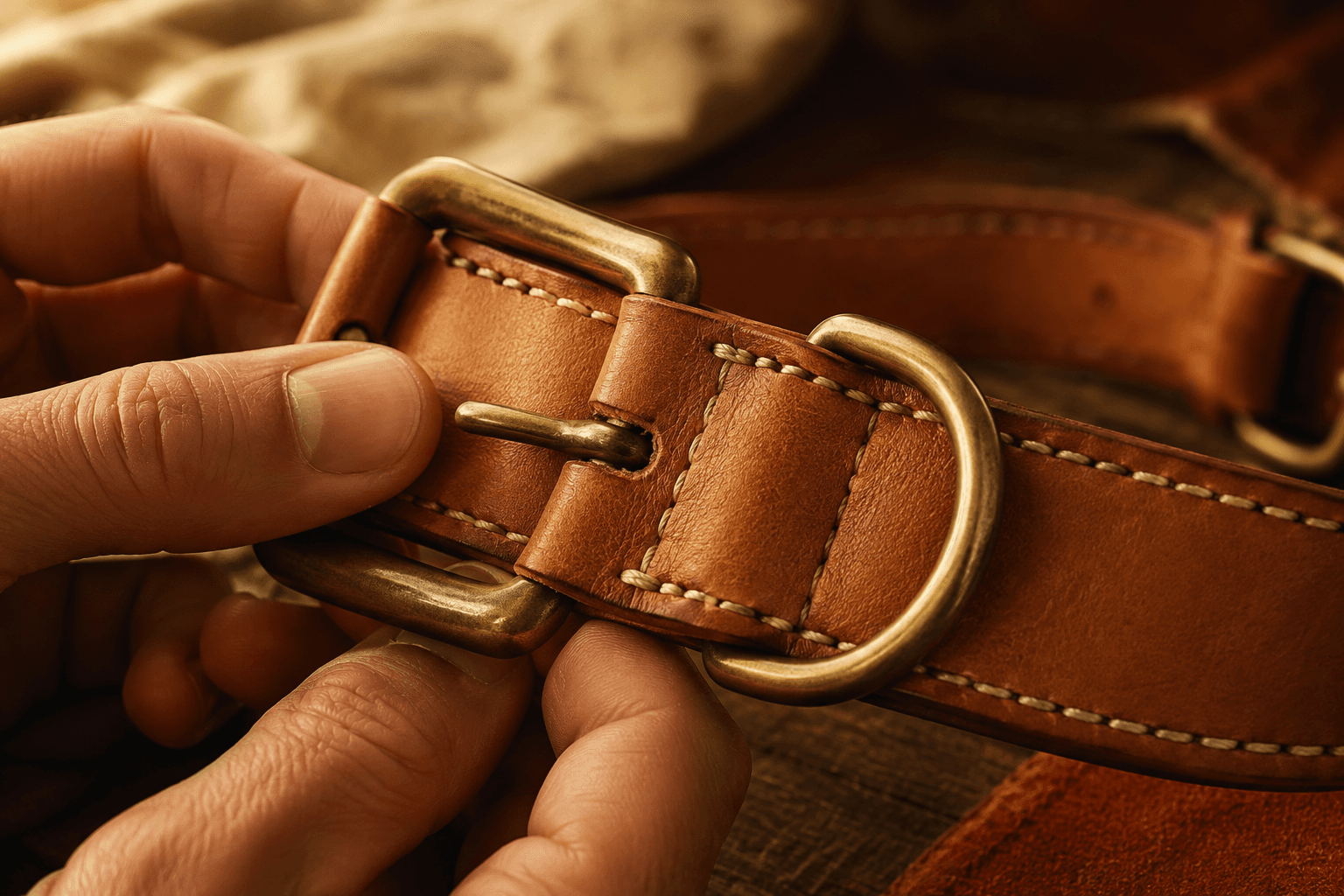
Run a thumb over the four points below as you clip the lead on. It takes about as long as putting the collar on and it is the entire routine.
- The buckle. Tongue seated in a hole, frame not bent, no play in the rivets holding it.
- The D-ring or attachment ring. Closed, not opening at the weld, not worn flat where the snap runs on it.
- The stitching. Especially at the folded ends and around any ring tab. One loose stitch is the start, not the end.
- The leather itself. No cracking across the grain, no soft or spongy patch, no stretch appearing at the holes.
If any of those looks wrong, stop using the item. Replace it or have it repaired before the next walk. The Spare Hardware Kit exists so that a worn buckle is a repair rather than a new collar.
How we talk about load
Where we publish a pull figure it is measured under static test conditions: a steadily increasing load applied to a new sample until failure, in a laboratory, at room temperature.
A static figure is not a dynamic impact limit. A 30 kg dog hitting the end of a lead at a run generates a peak force far above its body weight, for a fraction of a second. No static number tells you what a specific item will do under that, and anyone who implies otherwise is selling you a feeling rather than a fact.
It is also not a guarantee for your individual item. A sample from a batch is not the strap on your dog after two winters of rain.
Where we have not yet had a batch tested, the product page says so instead of showing a number. We would rather look incomplete than look confident about something we have not measured. Certificates are added to the pages as they come in from our suppliers, and you can ask us for the current status of any batch at support@haroldssswaren.shop.
What our equipment is not for
- Not for tethering an unattended dog. Not to a post, a bike rack, a shop front or a tree. A tethered dog that panics can injure itself against equipment that holds perfectly well.
- Not a vehicle restraint. Securing a dog in a car requires a system tested for crash loads. Nothing here is designed, tested or approved for that, and a collar or harness clipped to a seatbelt is not a substitute.
- Not climbing, towing, canicross or bikejoring equipment. These are walking articles.
- Not a muzzle, and not a substitute for one where one is legally required.
When to replace something
There is no fixed expiry date, because a lead used twice a day in coastal weather ages differently from one used on dry pavements. As a working guide:
- Daily use: look properly, not just by feel, every three months. Expect to replace a hard-working collar or lead somewhere between two and five years.
- After a soaking: dry flat, away from heat, then re-oil. Leather dried on a radiator becomes brittle and stays brittle.
- After any hard incident — a dog hitting the end of the line at speed, a lead caught in a car door — inspect the whole run and replace anything deformed.
- Puppies: re-measure the neck every two to three weeks and move up before the last hole.
Cats
A cat collar must be a breakaway design that releases under load if it snags. Every cat collar we sell is one, and none of them has a lead ring, because a collar that cannot release must never be put on an animal that climbs. Do not use a dog collar on a cat.
What this shop does not sell, permanently
German animal welfare law — the Tierschutzgesetz and the Tierschutz-Hundeverordnung — prohibits training devices that cause pain, injury or suffering. We hold to that as a permanent product rule, not a stock decision. We do not sell, source, quote for, recommend or link to:
- electric or shock collars of any kind, including “vibration-only” models sold as a gateway to them;
- prong or pinch collars;
- slip collars and chains that keep tightening with nothing to arrest them;
- spray or ultrasonic correction devices.
The rule is enforced in our own systems as well as in our heads: the category list is a hard-coded constant, and no product can be added to this catalogue without an explicit confirmation that it falls into none of those categories.
The one slip-style piece we do make is a martingale with a mechanical stop: the loop closes to a set point and cannot close further. The stop is a riveted physical part, not a setting, and it is visible in the product photograph.
What we do not claim
We make no claim that anything we sell repels or controls pests, kills bacteria, removes odour, calms a dog, treats anxiety, or produces a training outcome. Those claims belong to regulated product categories we do not operate in, and most of them would be unlawful on a leather article in any case.
A front attachment ring changes where a lead pulls from. That is a mechanical statement and it is as far as we will go. It does not replace training, and no piece of leather does.
Materials and chewing
Every leather article involves tanning agents and dyes. Ours meet REACH Annex XVII limits — chromium VI at ≤ 3 mg/kg, azo dyes within limits, metal fittings within the nickel release limit — and supplier declarations are on file.
Even so: do not let a dog chew leather goods for extended periods. A collar is worn, not eaten, and a dog that works at one persistently should be given something intended for chewing instead. We do not sell those.
Ask us
If something on a piece you own looks wrong and you are not sure, send a photograph to support@haroldssswaren.shop or call +49 1709855495. We would much rather look at a picture of a suspicious seam than hear about it afterwards.