
What you need
A soft tailor’s tape. If you do not have one, a length of string and a ruler works exactly as well: wrap the string, mark it with your thumb, lay it flat and read the length. A rigid metal tape does not follow a neck and will read short.
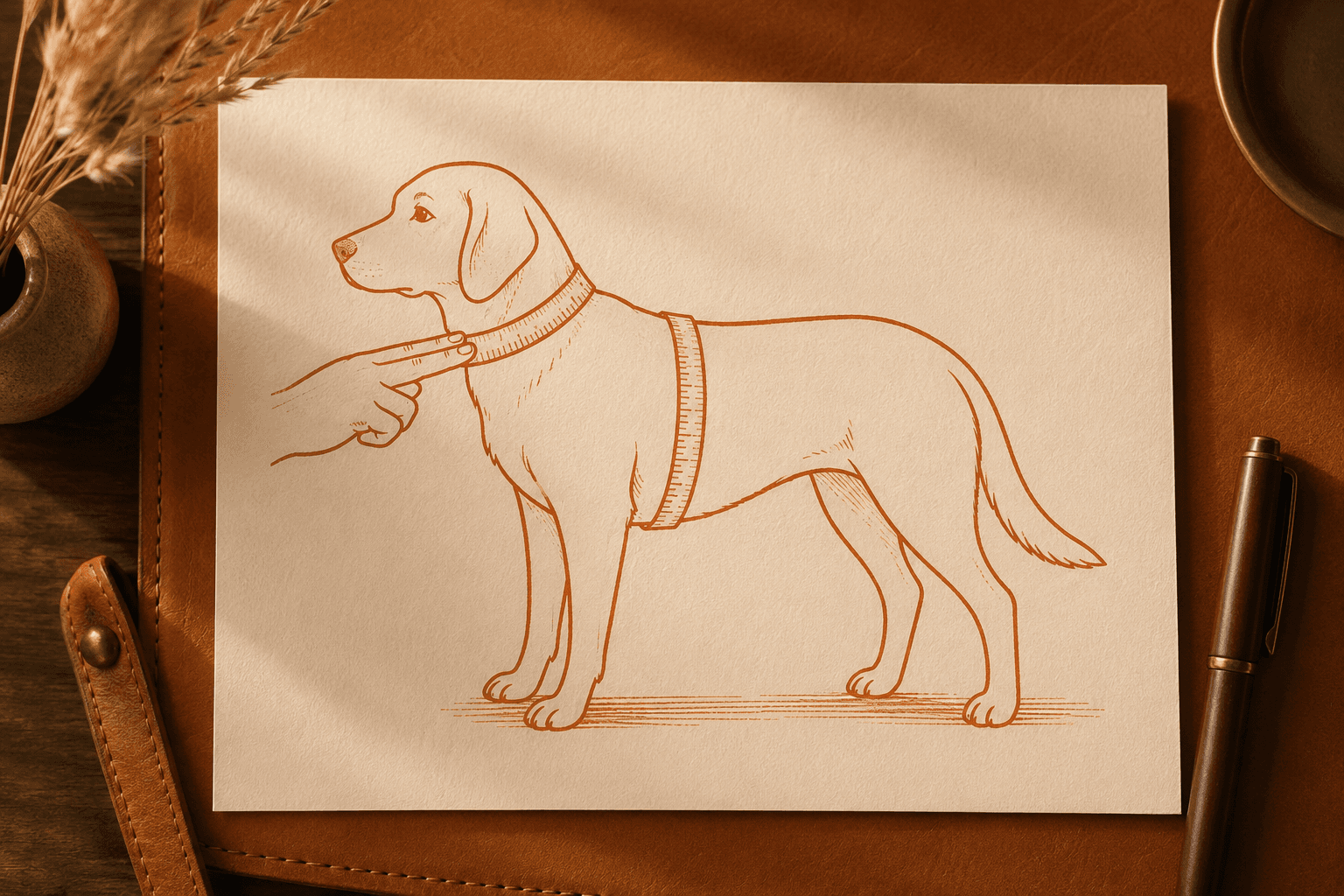
Neck — for a collar
- Have the dog standing, not sitting. A sitting dog’s neck reads differently.
- Wrap the tape around the neck where the collar will actually sit — low, just above the shoulders, not high behind the ears.
- Pull it snug against the coat, not tight into it.
- Slip two fingers flat under the tape and read the number with them in place. That is your measurement.
On a long or thick coat, part the hair and measure against the skin as well, then use the larger of the two numbers. A double coat can hide three centimetres.
Chest — for a harness
- Again with the dog standing.
- Wrap the tape around the ribcage just behind the front legs, at the deepest point of the chest.
- Snug, then two fingers under it, then read.
Two dogs with the same chest circumference can be shaped completely differently — one deep and narrow, one shallow and barrel-ribbed. That is why our larger harnesses have three adjustment points rather than one.
The two-finger rule, and why it is not more
Two flat fingers under the strap is the standard slack: enough that the coat is not compressed and the dog can swallow and turn freely, not so much that the collar rides over the ears when the dog backs up. Three fingers is a collar a determined dog reverses out of. One finger is a collar that rubs.
Breed is not a size
We do not publish a breed-to-size chart, and we will not, because the variation inside a single breed is larger than the gap between two of our width bands. Two dogs, same breed, same age, same shoulder height, six centimetres apart at the neck is entirely ordinary.
You can tell the fit tool the breed if you like. It records it and shows it back to you, and that is the whole of what it does with it — the calculation runs on your centimetres.
Between two sizes?
Take the larger one. Our collars have five to ten adjustment holes, so a band that starts slightly loose has somewhere to go. A band that is at its last hole on day one does not.
Puppies
A puppy’s neck can change in a fortnight. Choose the widest adjustment range available rather than the closest fit, re-measure every two to three weeks, and move up before you reach the last hole. Our Puppy Adjustable Collar covers a 10 cm range for exactly this reason.
Cats
Same method, gentler hands, and the collar must be a breakaway design. Measure the neck with the coat flat and add the two fingers as usual. A cat collar is never used for a lead.
Outside every band
Our stocked range runs from 18 to 60 cm at the neck and 30 to 84 cm at the chest. Outside that, the fit tool will not offer you the closest size — it will send you to a made-to-measure enquiry, because the closest size is a return waiting to happen.
Then use the numbers
With a measurement in hand, the fit tool narrows forty-three pieces down to two or three, and tells you why.